Tree Removal In Springboro OH
Springboro's Go-to Family Team For Tree Removal
Proudly Serving Centerville and Surrounding Communities, Including Kettering, Dayton, West Carrollton, Waynesville, Beavercreek, Bellbrook, and Springboro
What Springboro Homeowners Are Dealing With When a Tree Becomes a Problem
Knowing the Difference Between a Tree That Needs Trimming and One That Needs to Go
Springboro neighborhoods were developed decades ago, and the trees planted then have grown into full, heavy-canopy specimens. Tree removal is a practical reality for many residents, not because anything went wrong, but because mature trees on older lots eventually outgrow their space. Fences, rooflines, driveways, and utility lines are all closer than they used to be.
So how do you know if your tree actually needs to come down? Dead branches concentrated through the upper crown are one of the clearest signs. A leaning tree that has shifted position recently, especially after wet ground conditions, is worth taking seriously. Root damage from construction, grade changes, or disease can quietly compromise a tree’s structural integrity long before it looks obviously sick.
Not every problem tree needs full removal. Tree trimming handles many situations, like crossing branches, low limbs over a roof, or a canopy that’s grown too wide for the space. A proper tree health assessment looks at the whole picture – the roots, the trunk, the branch structure- and tells you which direction makes sense.
If you’re looking at a dead tree in your yard, the question isn’t really whether to remove it. It’s when. Dead wood doesn’t get more stable over time. Removing it now means a safer yard and a decision you won’t have to revisit.
Ask Us About Our Tree Removal Services
What Happens During a Tree Removal Job
Every Step Explained So You Know Exactly What to Expect on the Day
It starts with a free estimate. James comes out, looks at the tree, checks what’s around it, and gives you a straight number. No pressure, no obligation.
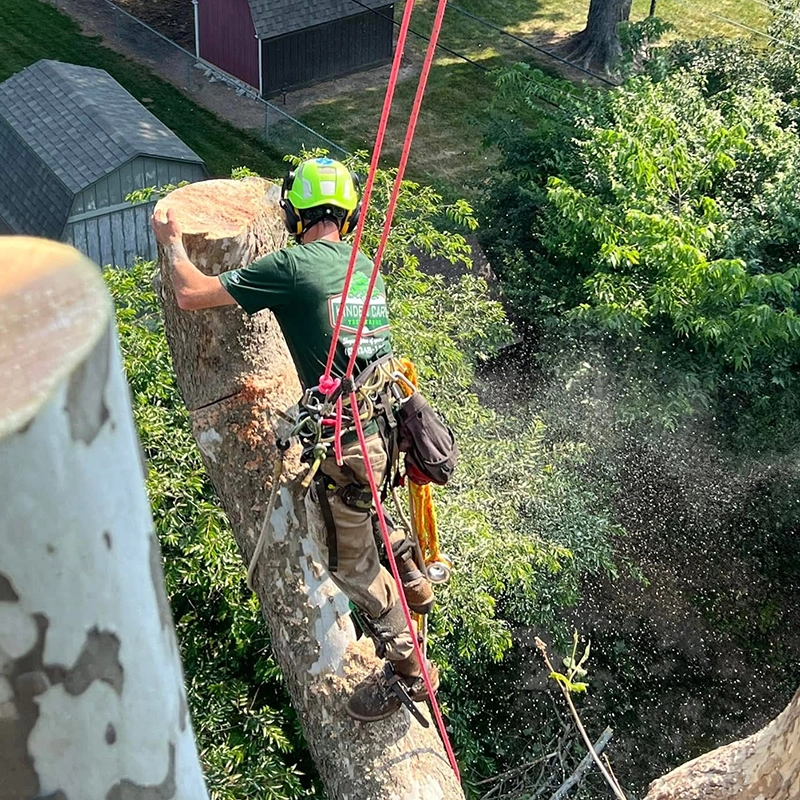
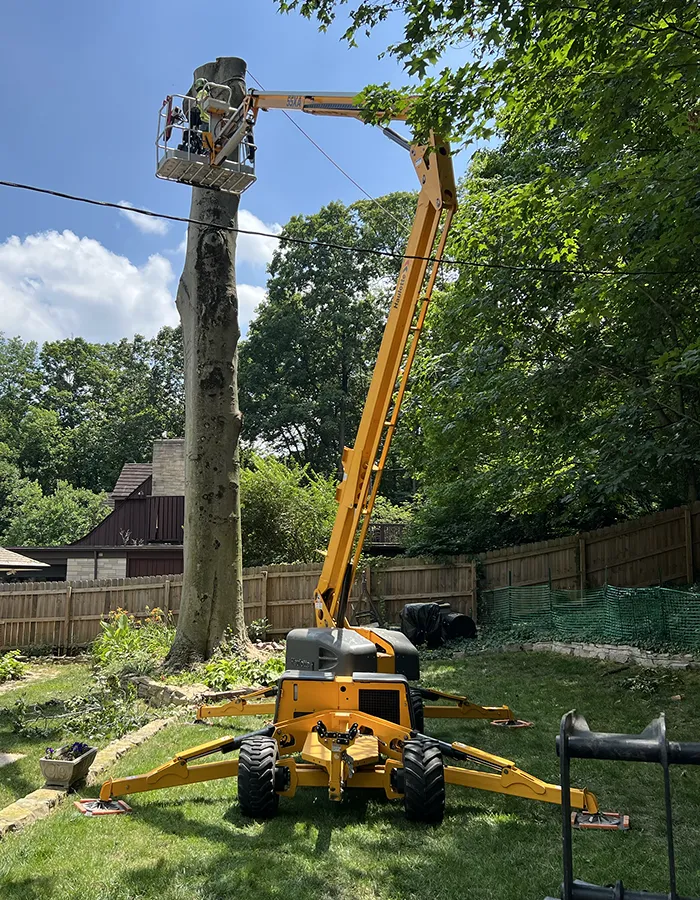
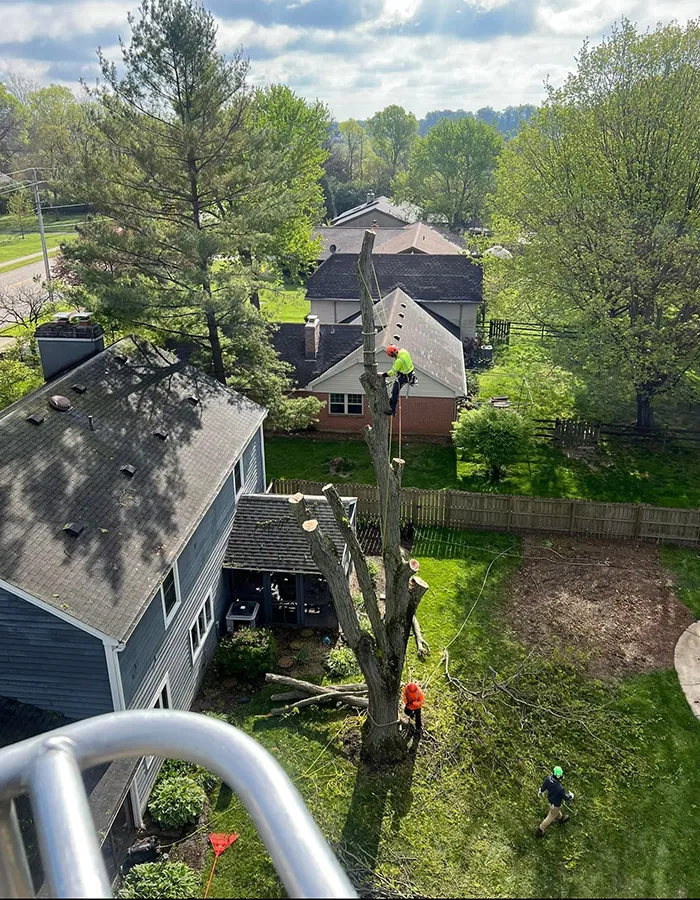
Once you’re ready to move forward, the crew shows up with the right equipment. We use a bucket truck when height or nearby structures make ground-based cutting unsafe. For tree cutting that requires working in sections, the tree comes down in pieces, not all at once. That controlled approach protects your fence, your roof, and anything else nearby.
Fallen tree removal works the same way. If the tree is already down, the crew cuts it into manageable sections, loads it out, and clears all the brush. Nothing gets left in a pile for you to deal with later.
Stump grinding happens after the tree is out. The stump gets ground down below ground level so you’re not tripping over it or working around it when you mow. If you want the wood from the removed tree set aside as firewood, just say so when you book.
Debris removal is included, full stop. Every branch, every wood chip, every piece of brush gets loaded and hauled away. You get a clean yard when the crew leaves, not a cleanup project waiting for you on the weekend.a structurally sound tree and extend its life. Other times, diseased tree removal is the only safe path forward. Knowing which situation you’re in is exactly what a proper assessment delivers.
Why Hiring a Local Springboro Tree Service Is Different From Calling a Regional Company
A regional company sends whoever is available. That might be a subcontractor from two counties over who has never worked near the tight residential lots along the Ohio 741 corridor and has no reason to care what your yard looks like when they leave. A locally based tree service operates differently because the people doing the work live near the same neighborhoods they’re working in.
With a family-owned operation that has been doing residential tree removal in Springboro for years, you’re not talking to a dispatcher. You’re talking to someone who has removed large trees from properties like yours, knows what that terrain looks like, and understands the specific challenges of tree removal near structures in established subdivisions.
If you ever want to verify who you’re hiring, you can. Ask a neighbor. Check with someone on your street. That kind of accountability doesn’t come with a regional company that rotates crews.
On the insurance side, the comparison matters too. A licensed and insured tree service carries both liability insurance and workers’ compensation insurance. If a crew member is injured on your property and the company doesn’t carry workers’ comp, you’re on the hook.
For large tree removal near fences, driveways, or structures, the crew’s familiarity with local conditions isn’t a soft benefit. It directly affects how the job gets done and what your property looks like afterward.
Trees Don't Stay the Same. Here's What Changes When You Wait
Small Signs That a Tree Is Declining and What They Mean for Your Property
Most people assume that if a tree hasn’t fallen or caused obvious damage, it’s fine. That assumption doesn’t hold up when you understand how tree decline actually works.
A tree dealing with root damage, tree disease, or a pest infestation doesn’t show its worst symptoms right away. The visible changes come later, after the structural damage is already done. By the time a tree looks clearly hazardous, the internal decay has often been progressing for years.
Many neighborhoods in Springboro have some of the densest residential tree cover in this area. Mature ash trees along those streets are particularly vulnerable to emerald ash borer, a tree pest infestation that kills from the inside out. Canopy thinning and dead branches near the top are often the first things you notice, but the damage below the bark started long before that.
If you’ve spotted deadwood in the upper crown, patches of missing bark, or unusual leaf drop, pay attention. None of those signs mean you automatically need removal. A proper tree risk assessment can tell you whether tree preservation is still possible or whether the tree has passed the point where plant health care can make a difference.
Trees don’t hold still while you wait for a better time to deal with them. A declining tree becomes a more complicated job as structural integrity weakens over time. Getting an honest look at it early means you’re making an informed decision, not a reactive one.
Tree Removal
Safe efficient removals
Tree Trimming
For beautiful, healthy trees
Precision Pruning
Improve structure, safety, and tree health
Emergency Tree Services
Emergency tree services to keep you safe
Stump Grinding
Restore usable outdoor space.
Cabling And Bracing
Support weakened limbs, reduce failure risk
How to Get a Tree Removed in Springboro Without the Runaround
What to Do Next If You Have a Tree You Want Looked At
You’ve got a tree you’re not sure about. Maybe it’s leaning. Maybe it came down in a storm, and it’s sitting on your fence right now. Maybe it’s been on your list for months, and you haven’t called anyone because the last contractor never returned your call.
Reaching out is straightforward. You contact us, James comes out to look at the tree, and we give you a clear number for tree removal. No obligation. For storm damage or anything urgent, we offer 24/7 emergency service.
Trees near power lines are one of the most common reasons people call. If that’s your situation, don’t wait. That’s one scenario where moving sooner matters more than timing it right.
If you’re not sure whether the tree needs full removal or something less, say that when you call. We’ll tell you honestly what we think. If stump grinding makes sense after the tree comes down, we handle that too. Commercial tree care, fallen tree removal, storm damage cleanup – it’s all covered under one job.
One thing to know: some removals in Springboro require a tree removal permit, depending on location and tree size. We can walk you through whether that applies to your situation before we start any work.
The next step is just a conversation. You describe what you’ve got, we take a look, and you get a straight answer.